
A founder recently asked a question that probably resonates with many growing teams. They had three tools for three purposes. It worked on paper. In practice it was slowly becoming a problem.
1.The Fragmented Stack
A founder recently asked a question that probably resonates with many growing teams. Their stack looked something like this.

On paper this setup works. But in practice it slowly turns into chaos.
- Nobody remembers which tool is used for what
- Client calls happen on one platform
- Internal meetings happen on another
- Async conversations live somewhere else
So naturally the idea comes up. Why not consolidate everything into one platform? It sounds logical. It saves money. It simplifies operations.
But then a new problem appears. The team.
2.Why Teams Resist Consolidation
When leaders think about consolidation, they usually think about efficiency.
But employees think about familiarity.
Every tool they use has become part of their workflow.
- Someone prefers Telegram because it is fast
- Someone likes Zoom because they know the interface well
- Someone relies on a specific phone system feature
When you suddenly introduce a new tool, the reaction is often emotional. People worry that the new system will make their work harder.

3.The Problem Is Not Too Many Tools
One interesting insight from many teams is this.
The problem is rarely just the number of tools.
The real problem is unclear communication rules. Without clear rules, teams end up asking questions like:
- Where should client calls happen?
- Where do internal discussions go?
- Where should updates be posted?
4.Before Consolidating, Try These Three Things
Many teams that successfully simplify their communication stack start with a small exercise.
1. Map what each tool is actually used for.
Write down what every platform currently does internal chat, client calls, async updates, team meetings. You will often discover that tools overlap heavily.
2. Identify duplication.
In many cases around 30 to 40 percent of functionality is duplicated across tools. Two platforms may both support messaging. Three tools may support video calls. Once you see the overlap clearly, consolidation decisions become easier.
3. Run a small pilot.
Instead of forcing the entire team to switch immediately, test the new system with a small group first. Three or four team members is usually enough.

5.Why Consolidation Efforts Fail
Most failed transitions share the same pattern.
- People feel forced into a new system
- The new tool removes features they relied on
- There is no transition period to adapt
When this happens, something interesting occurs.
Employees quietly go back to their old tools. The new platform exists, but the old stack never truly disappears.
6.What Successful Teams Do Differently
Teams that manage consolidation well usually follow three principles.
- Declare one platform as the source of truth
- Set clear rules all client calls on one platform, internal chat on another
- Allow a transition period of around 30 days before fully shutting the old tools down
7.The Bigger Lesson Behind This Discussion
Communication tools multiply quickly as companies grow. Each tool solves a specific problem at the time. But over months or years the stack becomes fragmented.
The real challenge is not choosing the right platform.
It is creating clarity in how communication flows across the company. Without that clarity, even the best tool will fail.
8.Where Widgetkraft Fits Into This
Interestingly, the same fragmentation problem also exists on the customer side.
Many companies handle website engagement through separate tools.
- One for live chat
- Another for lead capture
- Another for feedback
- Another for automation
Just like internal communication stacks, these systems slowly become scattered.
Widgetkraft tries to solve that problem by creating a unified engagement layer for websites. Instead of managing multiple tools, teams can handle interactions with visitors in one place.
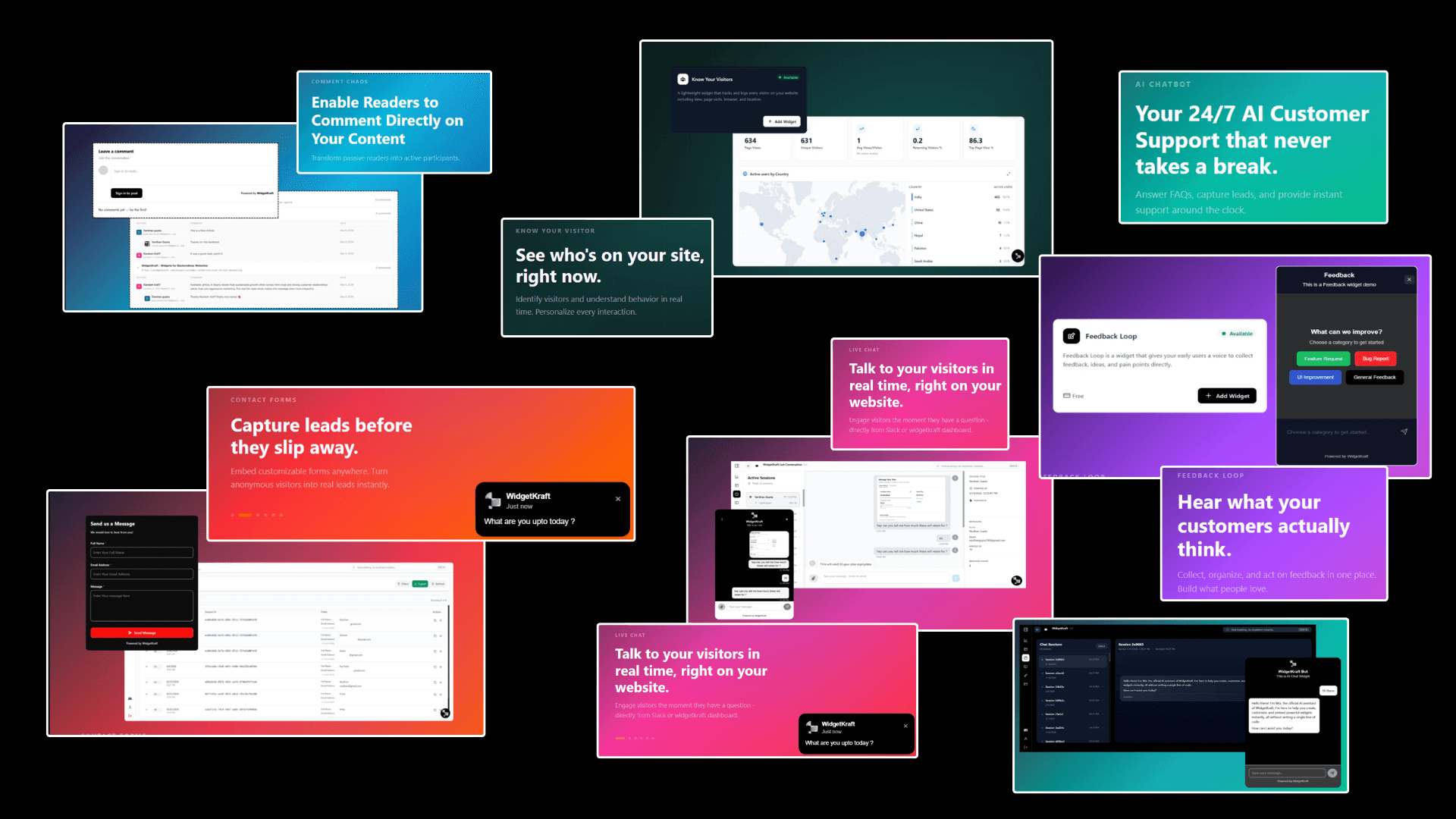
The same fragmentation happens on the customer side too.
Widgetkraft brings live chat, lead capture, feedback, and engagement monitoring into one place so your customer-facing stack stays as clean as you want your internal one to be.
Less fragmentation. Clearer communication flow. Simpler operations.